> For the complete documentation index, see [llms.txt](https://handbook.musescore.org/llms.txt). Markdown versions of documentation pages are available by appending `.md` to page URLs; this page is available as [Markdown](https://handbook.musescore.org/fr/text/rehearsal-marks.md).
# Repères
## Overview
**Rehearsal marks** (sometimes called Rehearsal Letters) can be used in a number of ways. e.g.
* To identify specific points in a score to facilitate rehearsing.
* As bookmarks in the score to which you can instantly navigate—using the [Find/Search](#finding-rehearsal-marks) command.
* To mark the various sections in the score.
**Rehearsal marks** are a type of [system text](/fr/text/staff-system-and-expression-text.md). In a full score they show only above the top staff of a [system](/fr/formatting/page-layout-concepts.md#system), but appear in all instrument [parts](/fr/basics/parts.md).
Rehearsal marks can be added to the score in two ways: (1) *manually*, allowing you to name them as you wish, or (2) *automatically*, which ensures that they are named in sequence
## Adding a rehearsal mark to your score
### Manual placement and naming
To create a rehearsal mark manually and give it a name of your own choosing:
1. Click on a note (or rest) at the desired location;
2. Select one of the following options:
* Press `Ctrl`+`M` (Mac: `Cmd`+`M`);
* From the menu, choose **Add→Text →Rehearsal Mark**;
3. Enter the desired text.
### Automatic placement and naming
MuseScore can name the **Rehearsal Marks** automatically. Do either:
* Click on a note (or rest) at the desired location, then click the \[B1] rehearsal mark icon in the "Text" [palette](/fr/customization/palettes.md)
* Drag and drop the rehearsal mark from the "Text" palette onto the score.
**Notes**: (1) By default, marks are added in the sequence, A, B, C etc. (2) To change the format of subsequently-added marks (to lower case letters, or numbers), edit the previous rehearsal mark accordingly. (3) Marks added between existing rehearsal marks append a number or letter to the previous mark: it is a good idea to apply the [Resequence](#resequence-rehearsal-marks) command afterwards (see below).
## Using measure numbers in rehearsal marks
If you want the rehearsal marks to be displayed as measure numbers:
1. Add the first rehearsal mark, then edit it to read the *same* as the number of the measure it is attached to;
2. Add subsequent marks as shown in [Automatic placement and naming](#automatic-placement-and-naming) (above). They will automatically adopt the measure-number format.
## Resequencing rehearsal marks
MuseScore allows the user to automatically re-order a series of rehearsal marks if they have got out of sequence for any reason. Use the following method:
1. Before making a selection, you can, if desired, establish a new format for the rehearsal marks (lower/upper case, number, or measure number) by manually altering the first mark in the range accordingly.
2. Select the range of measures you wish to apply the **Resequence** command to (if there is no selection then the program assumes you wish to resequence all measures).
3. From the menu, select **Tools→Resequence Rehearsal Marks**.
MuseScore automatically detects the sequence based on the *first rehearsal mark* in the selection—all rehearsal marks in the selection are then altered accordingly. The following sequences are possible:
* A, B, C etc.
* a, b, c etc.
* Numerical: 1, 2, 3 etc.
* Numerical: according to measure numbers.
## Finding rehearsal marks
See [Find / Go to](/fr/navigation/navigating-your-score.md#findgo-to) (Navigating your score).
## Repeating rehearsal marks on other staves
In most full scores any **Rehearsal marks** are shown only above the topmost staff of a system, but appear in all the generated instrument [parts](/fr/basics/parts.md). If duplicate marks are required on lower staves they should be added as [staff text](/fr/text/staff-system-and-expression-text.md).
[Some templates](/fr/introduction/create-your-first-score.md) have an additional feature, e.g. *Symphony Orchestra* or *Classical Orchestra*, see the list of templates in [Staff Text and System Text](/fr/text/staff-system-and-expression-text.md#repeating-system-text-on-other-staves) chapter. On a new score created using either of the two templates listed abve, when you create a rehearsal mark above the top staff, an identical one is automatically added just above the string section. If either instance of the mark is edited the content of both is updated. If either one is removed, both are removed.
## Changing appearance of rehearsal marks
By default, rehearsal marks appear in a large bold font, enclosed in frames, and aligned to the center of the start barline of the measure. You can edit the *default* text properties from **Format→Style→**[**Text style**](https://musescore.org/en/handbook/3/text-styles-and-properties).
## Rehearsal mark properties
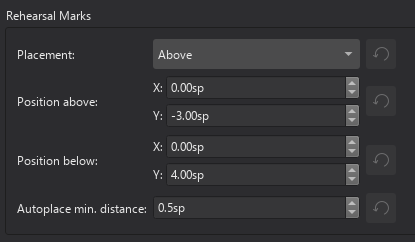
The properties of selected **rehearsal marks** can be changed in the [Properties Panel](/fr/basics/properties-panel.md).
## Rehearsal mark style
*See* [*Templates and styles*](/fr/customization/templates-and-styles.md)*.*
Values of the "Style for Rehearsal marks" can be edited in **Format→Style→Rehearsal marks**.\
Values of the "Style for text inside Rehearsal mark" can be edited in **Format→Style→Text styles→Rehearsal mark**
## External links
* [Rehearsal letter](https://en.wikipedia.org/wiki/Rehearsal_letter) (Wikipedia article)
---
# Agent Instructions
This documentation is published with GitBook. GitBook is the documentation platform designed so that both humans and AI agents can read, navigate, and reason over technical content effectively. Learn more at gitbook.com.
## Querying This Documentation
If you need additional information that is not directly available in this page, you can query the documentation by asking a question.
Perform an HTTP GET request on the following URL with the `ask` and `goal` query parameters:
```
GET https://handbook.musescore.org/fr/text/rehearsal-marks.md?ask=&goal=
```
`ask` is the immediate question: it should be specific, self-contained, and written in natural language.
`goal` is what the user is ultimately trying to achieve, the reason they need the answer. Sharing it helps GitBook give you a better, more relevant answer. A goal is most helpful when it describes the outcome the user wants rather than restating the question. For example, with `ask=how do I create an API token`, a goal like `automate deployments from our CI pipeline` lets GitBook tailor the answer to that use case.
The response will contain a direct answer to the question and relevant excerpts and sources from the documentation.
Use this mechanism when the answer is not explicitly present in the current page, you need clarification or additional context, or you want to retrieve related documentation sections.