> For the complete documentation index, see [llms.txt](https://handbook.musescore.org/llms.txt). Markdown versions of documentation pages are available by appending `.md` to page URLs; this page is available as [Markdown](https://handbook.musescore.org/fr/appendix/glossary.md).
# Glossaire
Listed below are technicial terms and musical terms, which are frequently used in MuseScore or in the Handbook. Links to relevant handbook chapter are provided. To help musicians who are capable of reading a notation but do not know its proper name, image is provided. This chapter does not aim to be a dictionary of all musical notations, see [External links](#external-links).
The differences between American English and British English are marked with "(AE)" and "(BE)", respectively. Editors and translators of this chapter should add the individual entry for each term.
### A
* Acciaccatura
A short [grace note](#grace-note) which appears as a small note with a stroke through the stem. Musescore creates a quick playback, the playback duration is not affected by duration of the parent note.
* Altération
An accidental is a sign appearing in front of a note that raises or lowers its pitch. See [Entering notes and rests:Accidentals](/fr/basics/entering-notes-and-rests.md#accidentals). chapter. Musescore creates playback for common accidentals only, they includes [sharps](#sharp), [flats](#flat), [naturals](#natural), [double sharps](#doublesharp), [double flats](#doubleflat), and triple flats. To create microtonal accidentals such as quarter tone, see [Tuning systems, microtonal notation system, and playback](https://musescore.org/en/handbook/3/tuning-systems-microtonal-notation-system-and-playback) Chapter.
* Ambitus
Note (or vocal) range used in a [staff](#staff). Used particularly in early music. See [Ambitus](/fr/notation/pitch/ambitus.md) chapter.
* Anacrusis (mostly BE)
See [Pickup measure](#pickup-measure).
* Point d'ancrage
The point of attachment to the score of objects such as Text and Lines: When the object is dragged, the anchor appears as small brown circle connected to the object by a dotted line. Depending on the object selected, its anchor may be attached to either (a) a note (e.g. fingering), (b) a staff line (e.g. staff text), or (c) a barline (e.g. repeats).
* Appoggiature
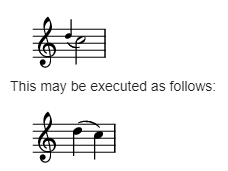
A long [grace note](#grace-note) which takes value from its associated note. Musescore creates playback as such. It is acceptable to execute written appoggiatura as acciaccatura nowadays but Musescore does not create such playback. Appoggiatura's functions include: passing tone, anticipation, struck suspension, and escape tone.\\
* Arpège
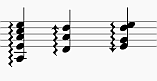
An **arpeggio** tells the performer to break up the chord into the constituent notes, playing them separately and one after the other. The arrow arpeggio symbol indicates the direction in which the player should play the notes of the chord. See [Arpeggios and glissandi](/fr/notation/expressive-markings/arpeggios-and-glissandos.md) chapter.\\
* Articulation
A marking or symbol indicating how a note should be played, usually by altering the length of a note or shaping its attack and decay. See [Articulation](/fr/notation/expressive-markings/articulations.md) chapter.
### B
* Bar (BE)
See [measure](#measure).
* Barre de mesure
Vertical line through a [staff](#staff), staves, or a full [system](#system) that separates [measures](#measure). See [Barline](/fr/notation/rhythm-meter-and-measures/barlines.md) chapter.
* Ligature
Notes with a duration of an [eighth](#eighth-note) or shorter either carry a [flag](#flag) or a beam. Beams are used for grouping notes. See also [French Beam](#french-beam). See [Beam](/fr/notation/rhythm-meter-and-measures/beams.md) chapter.
* BPM
A tempo displaying unit only used inside Musescore's Play toolbar. BPM is the amount of **quarter notes** would have been within one minute. It is **not** the number used in [metronome tempo markings](#metronome-mark) on a score. See [Playback controls](/fr/sound-and-playback/playback-controls.md) chapter.
* Breve, or Brevis
A **double whole note** or **breve** is a note that has the duration of two whole notes.
### C
* Césure
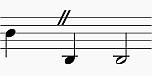
A **caesura** (//) is a brief, silent pause. Time is not counted for this period, and music resumes when the director signals. See [Breaths and pauses](/fr/notation/expressive-markings/breaths-and-pauses.md) chapter.\\
* Capo (text)
A text to indicate the setting of the transposing device used on an instrument. See [Applying capos](/fr/idiomatic-notation/guitar/applying-capos.md). Not to be confused with [Da capo (D.C.)](#da-capo).
* Cent
An interval equal to one hundredth of a semitone, used by Tuning property of a note. See [Properties panel](/fr/basics/properties-panel.md#inside-the-playback-tab) chapter.
* Accord
* 1\. A group of two or more notes sounding together.
* 2\. In Musescore, only notes sounding together that have same duration inside one [Musescore Voice](#voice) constitute a chord. To select a chord in MuseScore, press `Shift` and click on a note. See [Working with multiple voices](/fr/basics/working-with-multiple-voices.md) chapter.
* 3\. In Musescore, a chord symbol. See [Chord symbols](/fr/text/chord-symbols.md) chapter.
* Clef
A musical symbol used to indicate which notes are represented by the lines and spaces on a →[staff](#staff). See [Clefs](https://musescore.org/en/handbook/3/clefs) chapter. See also [courtesy clef](#courtesy-clef).
* Coda
* 1\. A passage that brings a piece (or a movement) to an end.
* 2\. The navigation marker which resembles a set of crosshairs. It is used where the exit from a repeated section is within that section rather than at the end. See also [segno](#segno) sign. See [Jumps and markers](/fr/notation/repeats/jumps-and-markers.md) chapter.
*
```
```
* Tonalité réelle
* 1\. The sounding, or real pitch of a note—as opposed to the [written pitch](#written-pitch). See [Working with transposing instruments](/fr/notation/pitch/transposition.md#working-with-transposing-instruments) chapter.
* 2\. A score viewing mode in Musescore, see [Concert pitch box in the status bar](/fr/notation/pitch/transposition.md#transposed-and-concert-pitch) chapter.
* 3\. The frequency of A4.
* Courtesy clef
A reduced-size [clef](#clef) applied to the end of a system indicating a clef change at the start of the next system. See [Clefs](/fr/notation/pitch/clefs.md) chapter.
* Notation entre portées
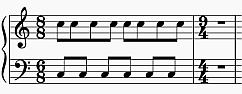
* A musical phrase extending across two neighboring staffs: e.g. bass staff and treble staff.
*
```
```
* To create notation where the two stems are at opposite sides of the beam, as shown above, see [Cross-staff notation](/fr/idiomatic-notation/keyboard/cross-staff-notation.md) chapter.
*
```
```
* To create notation where the stems are on the same side of the beam, as shown above, see [How to span a chord or stem over two staves](https://musescore.org/en/node/8717) chapter.
* Crotchet (BE)
See [Quarter note](#quarter-note).
### D
* Da capo (D.C.)
A directive to repeat the previous part of music. See [Jumps and markers](/fr/notation/repeats/jumps-and-markers.md) chapter. Not to be confused with [capo (text)](#capo-text).
* Dead note
See [ghost note](#ghost-note).
* Demisemiquaver (BE)
A thirty-second note.
* Double bémol
A **double flat** (♭♭ or 𝄫) is a sign that indicates that the pitch of a note has to be lowered two semitones.
* Double dièse
A **double sharp** (♯♯ or 𝄪) is a sign that indicates that the pitch of a note has to be raised two semitones.
* Duolet
See [tuplet](#tuplet).
* Dynamic, dynamics, dynamic symbol, dynamics symbol
A symbol indicating the relative loudness of a note or phrase of music—such as ***mf*** (mezzoforte), ***p*** (piano), ***f*** (forte) etc., starting at that note. See [Dynamic](/fr/notation/expressive-markings/dynamics-and-hairpins.md) chapter.
### E
* Edit mode, text edit mode
Used to edit adjust literal layout position and content of Text, contrast with [normal mode](#normal-mode) and [note input mode](#note-input-mode). See [Adjusting elements directly](/fr/basics/adjusting-elements-directly.md) and [Entering and editing text : Editing text object content](/fr/text/entering-and-editing-text.md#editing-text-object-content) chapters.
* Croche
A note whose duration is an eighth of a whole note (semibreve). Same as a **quaver** (BE).
* Endecalineo\
\*
```
```
* Endecalineo or endecagram, the stave for Solfège. See [Solmisation](https://musescore.org/en/node/318182) (tutorial for MuseScore 3, pending update)
* Endings
See [volta](#volta).
* Enharmonic notes
Notes qui sonnent de manière identique mais qui sont écrites différemment. Par exemple : sol♯ et la♭ sont enharmoniques. Pour basculer rapidement entre les notations enharmoniques, appuyez sur `J`. Voir le chapitre [Saisir des notes et des silences](/fr/basics/entering-notes-and-rests.md#selecting-pitch-using-a-midi-keyboard).
* Explode\
\*
```
```
* A feature that allows the user to split (or explode) the chords in a passage of music in a single staff into their constituent notes or voices. See [Implode and explode](/fr/notation/instruments-staves-and-systems/implode-and-explode.md) chapter. See also [implode](#implode).
### F
* Croche
See [beam](#beam).
* Bémol
Sign (♭) that indicates that the pitch of a note has to be lowered one semitone, see [accidentals](#accidental) and [key signature](#key-signature).
* French Beam\
\*
```
```
* Beams where the stems only extend to the first beam, but don't intersect all the way through. To create use the [French Beams](https://musescore.org/en/project/french-beams) plugin.
### G
* Ghost note
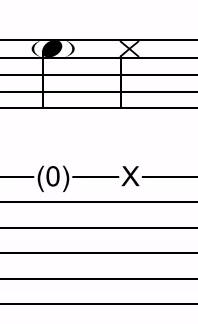
In music, notably in jazz, a ghost note (or a dead, muted, silenced or false note) is a musical note with a rhythmic value, but no discernible pitch when played. Musescore supports crosshead (cross notehead), diamond notehead(the small diamond same as musescore 3), slash/diamond notehead (new in musescore 4), and adding brackets (parentheses) to a note, see [Noteheads](/fr/notation/pitch/noteheads.md) chapter.\\
\\
* Grace note
Grace notes appear as small notes in front of a normal-sized main note. See [acciaccatura](#acciaccatura) and [appoggiatura](#appoggiatura). See [Grace note](/fr/notation/expressive-markings/grace-notes.md) chapter.
*
```
* Grand Staff(AE)
```
```
* Great Stave (BE)
An [instrument](glossary.md#instrument) with two or more staves, featuring treble and bass clefs, used to notate music for keyboard instruments and the harp, in MuseScore: Any number of Staves connected by a curly brace.
```
### H
* Blanche
A note whose duration is half of a whole note (semibreve). Same as a **minim** (BE).
* Hemidemisemiquaver (BE)
A sixty-fourth note.
### I
* Implode\
\*
```
```
* A feature allowing the user to combine voices from separate staves onto one staff. See [Implode and explode](/fr/notation/instruments-staves-and-systems/implode-and-explode.md) chapter. This is similar to, but not exactly, score reduction ([wikipedia](https://en.wikipedia.org/wiki/Reduction_\(music\))). See also [explode](#explode).
* Intervalle
The difference in pitch between two notes, expressed in terms of the scale degree (e.g. major second, minor third, perfect fifth etc.). See [Degree (Music)](https://en.wikipedia.org/wiki/Degree_\(music\)) (Wikipedia).
* Interleaved\
\*
```
```
* A term used to describe two interlocking, oppositely-beamed sets of notes. To create, use the voice function and the beam palette. See [Interleaved beam directions](https://musescore.org/en/node/314469#comment-1047136)
* Instrument
* 1\. Musescore Instrument, see [Setting up your score](/fr/basics/setting-up-your-score.md) chapter.
* 2\. Real world instrument
* Irregular measure marker\
\*
```
```
* A plus sign or minus sign at the top right of a measure indicates that its duration differs from that set by the time signature. See [The user interface](/fr/navigation/the-user-interface.md) and [Measure properties](/fr/notation/rhythm-meter-and-measures/measure-properties.md) chapters.
### J
* Saut
Jump objects are notations such as "D.S. al Coda", found in the "Repeats & Jumps" palette. See [Jumps and markers](/fr/notation/repeats/jumps-and-markers.md) chapter.
### K
* Armure
Set of [sharps](#sharp) or [flats](#flat) at the beginning of the [staves](#staff). It gives an idea about the tonality and avoids repeating those signs all along the [staff](#staff). A key signature with B flat means F major or D minor tonality. See [Key Signature](/fr/notation/pitch/key-signatures.md) chapter.
### L
* Legato
Legato is a play style which involves playing the notes in a slurred manner. Legato may be written as text or shown through the use of [slurs](#slur).
* Local time signature
The time signature on a single staff when different from the overall score time signature. See [Adding a local time signature for a single staff](/fr/notation/rhythm-meter-and-measures/time-signatures.md#adding-a-local-time-signature-for-a-single-staff).
* Longue
A **longa** is a **quadruple whole note**.
*
```
* Ledger Line(AE)
```
```
* Leger Line (BE)
Line(s) that are added with and for notes above or below the staff.
```
* Ligne
Musescore Lines, a type of objects capable of attaching (anchoring) to a horizontal continuous range of more than two notes or rests, or vertical collection of notes (chord). See [Other lines](/fr/notation/expressive-markings/other-lines.md) chapter.
### M
* Measure (AE)
A segment of time defined by a given number of beats. Dividing music into measures provides regular reference points to pinpoint locations within a piece of music. Same as [bar](#bar) (BE).
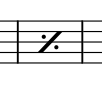
* Measure repeat sign
A measure repeat sign looks like a "percentage" symbol having the two circles filled, or a slash with a dot at each side. See [Measure and multi-measure repeats](/fr/notation/repeats/measure-and-multimeasure-repeats.md) chapter.\\
* Metronome mark
A kind of tempo marking. See [Tempo markings](/fr/text/tempo-markings.md).
* Minim (BE)
See [Half note](#half-note).
* Pause multimesures
See [Measure rests and multimeasure rests](/fr/notation/rhythm-meter-and-measures/measure-and-multimeasure-rests.md) chapter.\\
### N
* Bécarre
A natural (♮) is a sign that cancels a previous alteration on notes of the same pitch, see →[accidentals](#accidental) and →[key signature](#key-signature).
* Mode normal
The operating mode of MuseScore *outside* [note input mode](#note-input-mode) or [edit mode](#edit-mode): press `Esc` to enter it. In **Normal mode** you can navigate through the score, [select](/fr/basics/selecting-elements.md) and move elements, adjust Inspector properties, and alter the pitches of existing notes.
* Mode de saisie des notes
The program mode used for entering music notation, contrast with [normal mode](#normal-mode) and [edit mode](#edit-mode). Enter it by pressing `N` or clicking on the pen icon in the note input toolbar. See [Entering notes and rests](/fr/basics/entering-notes-and-rests.md#entering-note-input-mode) chapter.
### O
* Operating System (OS)
Underlying software that controls and manages the hardware and other software on a computer. Popular OSes are Microsoft Windows, macOS, and GNU/Linux.
* Ossia\
\*
```
```
* An alternative passage which may be played instead of the original passage (from the Italian for "alternatively", meaning "or be it"). See [Ossia](/fr/notation/instruments-staves-and-systems/showing-staves-only-where-needed.md#ossia) chapter.
### P
* Partie
* 1\. Musescore's automatic staff extraction function, see [Parts](/fr/basics/parts.md).
* 2\. A single melody line in a polyphonic musical composition. MuseScore 4 **never** uses this definition, but there is a similar feature [Voice](#voice).
* 3\. Instrument(s) or their staves. MuseScore 4.1.1 uses this definition only on the window title and one subheading in "Staff/Part Properties".
* Pickup Measure (mostly AE, also known as an Anacrusis (mostly BE) or Upbeat)
Incomplete first measure of a piece or a [section](#section) of a piece of music. See [Measure duration](/fr/notation/rhythm-meter-and-measures/measure-properties.md#measure-duration), [Create new score: Pickup measure](/fr/introduction/create-your-first-score.md#enter-score-info), and [Measure properties:Exclude from measure count](/fr/notation/rhythm-meter-and-measures/measure-properties.md#other) chapters. May or may not be compensated for at the end of the score or section.
* Propriétés
* 1\. Settings of an individual object on a score in Musescore, contrast with [style (profile)](#style).
* 2\. Musescore's panel, see [Properties panel](/fr/basics/properties-panel.md) chapter.
### Q
* Quartolet
See [tuplet](#tuplet).
* Noire
A note whose duration is a quarter of a whole note (semibreve). Same as a **crotchet** (BE).
* Quaver (BE)
See [eighth note](#eighth-note).
* Quintolet
See [tuplet](#tuplet).
### R
* Optimiser l'écriture des notes enharmoniques
Change accidental used on a note but keep note's pitch. See [Entering notes and rests:Accidentals](/fr/basics/entering-notes-and-rests.md#accidentals) chapter.
* Silence
A musical symbol that indicates silence. See [Entering notes and rests](/fr/basics/entering-notes-and-rests.md) chapter.
* Re-pitch mode
One of the note input modes. [Alternative note input methods: Re-pitch mode](/fr/basics/alternative-note-input-methods.md#re-pitch)
### S
* Partition
* 1\. In MuseScore support forums and the MuseScore Handbook, **score** generally refers to a computer file with the suffix .mscz - and to its visual representation on a computer screen as well as its audio playback.
* 2\. In some chapters of the MuseScore Handbook, **score** means the layout and formatting of "Full score" or one particular Musescore part. See [Musescore Part](/fr/basics/parts.md).
* 3\. In other contexts (for example the IMSLP score-sharing website at [https://imslp.org](https://imslp.org/)), a score generally refers either to a PDF file of the sheet music for a specific work or to an actual paper copy of the sheet music.
* Section
In MuseScore, a region of the score between [section breaks](/fr/formatting/using-sections-for-multiple-movements-or-songs.md); also from the start of a score to the first section break, and from the last section break to the end of the score.
* Segno
A navigation marker. See [Jumps and markers](/fr/notation/repeats/jumps-and-markers.md) chapter.
* Semibreve (BE)
A **whole note** (AE). It lasts a whole measure in 4/4 time.
* Semiquaver (BE)
A sixteenth note.
* Semihemidemisemiquaver (Quasihemidemisemiquaver) (BE)
A hundred and twenty eighth note.
* Sextolet
See [tuplet](#tuplet).
* SF2
A virtual instrument format developed by E-mu Systems and Creative Labs. See [SoundFonts](#soundfont).
* SF3
An invention of Werner Schweer, the Musescore developer ([source](https://musescore.org/en/node/151611#comment-618066)). This format supports sound sample compression. See [SoundFonts](#soundfont).
* Shared note head
A single notehead with two beams—one up, one down. Especially common in guitar music, for example. See [Noteheads](/fr/notation/pitch/noteheads.md#sharing-noteheads-between-voices)
* Dièse
Sign (♯) that indicates that the pitch of a note has to be raised one semitone , see [accidentals](#accidental) and [key signature](#key-signature).
* Slash (slash chord, slash notehead)
Indicates strum. See [Slash chord](https://en.wikipedia.org/wiki/Slash_chord) (Wikipedia).
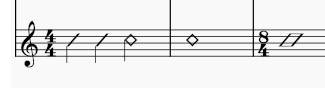
* Slash notation
A form of music notation using slash marks placed on or above/below the staff to indicate the rhythm of an accompaniment: often found in association with chord symbols. There are two types: (1) *Slash notation* consists of a rhythm slash on each beat: the exact interpretation is left to the player (see [Fill with slashes](/fr/alternative-notation/slash-notation.md#filling-a-range-with-beat-slashes)); (2) *Rhythmic slash notation* indicates the precise rhythm for the accompaniment (see [Toggle rhythmic slash notation](/fr/alternative-notation/slash-notation.md#creating-rhythmic-slash-notation)).
* Liaison de phrasé
A curved line over or under two or more notes, meaning that the notes will be played smooth and connected (*legato*). See [Slur](/fr/notation/expressive-markings/slurs-and-ties.md) chapter. A slur is not a [tie](#tie).
* Solmisation
see [Endecalineo](#endecalineo)
* SoundFont
A virtual instrument format supported by MuseScore. A **SoundFont** is a special type of file (extension .sf2, or .sf3 if compressed) containing sound samples of one or more musical instruments. In effect, a virtual synthesizer which acts as a sound source for MIDI files. MuseScore 4 comes with its own native soundfont, *MS Basic*. See [SoundFont](/fr/sound-and-playback/soundfonts.md) chapter.
* Spatium (plural: Spatia) / Space / Staff Space / sp. (abbr./unit)
A unit of measurement, see [Page layout concepts](/fr/formatting/page-layout-concepts.md).
* Staff / Staffs
A set of lines and spaces, each representing a pitch, on which music is written. In period music notation (before 11th century) the staff may have any number of lines.
* Staff Space
See [Spatium](#spatium) (above).
* Stave / Staves (BE)
See [Staff](#staff) (above).
* Step-time input
MuseScore's default [note input mode](#note-input-mode). See [Entering notes and rests](/fr/basics/entering-notes-and-rests.md#entering-note-input-mode) chapter.
* Style
The profile that contains settings in MuseScore, contrast with [Properties](#properties). See [Templates and styles](/fr/customization/templates-and-styles.md) chapter.
* Système
Set of staves to be read simultaneously in a score. See [Page layout concepts](/fr/formatting/page-layout-concepts.md#system) chapter.\
See also [Operating System (OS)](#operating-system).
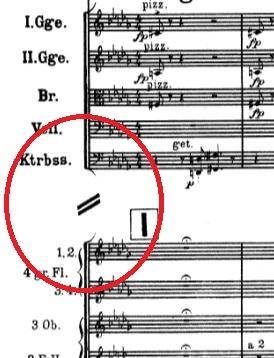
* Séparateur de système
Separates systems on the same page. Can be switched on for the score in **Format→Style→System**, see [Formatting](https://github.com/shoogle/Handbook/blob/fr/docs/formatting/README.md) chapter. Also available in master palette, see [Other symbols](/fr/notation/expressive-markings/other-symbols.md) chapter.\\
### T
* Texte
A Musescore Text object is an object that contains individual characters that can be entered and removed by using (typing on) a computer keyboard. See [Entering and editing text](/fr/text/entering-and-editing-text.md) chapter.
* Liaison de prolongation
A curved line between two adjacent notes of the same pitch to indicate a single note of combined duration. See [Tie](/fr/basics/entering-notes-and-rests.md#ties) chapter. A tie is not a [slur](#slur).
* Quarter note + Tie + Quarter note = Half note
* Quarter note + Tie + Eighth note = Dotted Quarter note
* Quarter note + Tie + Eighth note + Tie + 16th note = Double Dotted Quarter note
* Transposition
The act of moving the pitches of one or more notes up or down by a constant [interval](#interval). See [Transposition](/fr/notation/pitch/transposition.md) chapter. There may be several reasons for transposing a piece, for example:
1. The tune is too low or too high for a singer. In this case the whole orchestra will have to be transposed as well—easily done using MuseScore.
2. The part is written for a particular instrument but needs to be played by a different one.
3. The score is written for an orchestra and you want to hear what the individual instruments sound like. This requires changing the transposing instrument parts to concert pitch.
4. A darker or a more brilliant sound is desired.
* Triolet
See [tuplet](#tuplet).
* Division irrégulière
A tuplet divides its next higher note value by a number of notes other than given by the time signature. See [Tuplet](/fr/notation/rhythm-meter-and-measures/tuplets.md) chapter. For example a [triplet](#triplet) divides the next higher note value into three parts, rather than two. Tuplets may be: [triplets](#triplet), [duplets](#duplet), [quintuplets](#quintuplet), and other.
### U
* Levée
See [pickup measure](#pickup-measure).
### V
* Vélocité
A property of objects inside Musescore that controls how loudly note(s) are played, see musescore 3 handbook [Loudness of a note](https://musescore.org/en/handbook/3/dynamics#soundlevel) chapter. Velocity property of notes are edited using **Properties panel: Playback tab**, see [Properties panel](/fr/basics/properties-panel.md) chapter.
* Voix
* 1\. In Musescore, voice is a software feature, you can use up to 4 voices per staff, see [Working with multiple voices](/fr/basics/working-with-multiple-voices.md), also see [staff](#staff).
* 2\. The musical term "voice" refers to a musical line or part which can have its own rhythm. MuseScore does not have a feature to implement the exact same idea, if the voice feature does not suit your need, try adding separate instruments instead.
* Alternatives de reprise
In a repeated section of music, it is common for the last few measures of the section to differ. Markings called voltas are used to indicate how the section is to be ended each time. These markings are often referred to simply as [endings](#endings). See [Volta](/fr/notation/repeats/voltas.md) chapter.
### W
* Tonalité écrite
Transposing instruments (such as the clarinet, French horn, trumpet etc.) are notated at a different pitch (and key signature) to how they sound. The notated pitch is called the written pitch. Contrast with [concert pitch](#concert-pitch). See [Staff / Part properties](/fr/notation/instruments-staves-and-systems/staff-part-properties.md) chapter.
### External links
*
*
---
# Agent Instructions
This documentation is published with GitBook. GitBook is the documentation platform designed so that both humans and AI agents can read, navigate, and reason over technical content effectively. Learn more at gitbook.com.
## Querying This Documentation
If you need additional information that is not directly available in this page, you can query the documentation by asking a question.
Perform an HTTP GET request on the following URL with the `ask` and `goal` query parameters:
```
GET https://handbook.musescore.org/fr/appendix/glossary.md?ask=&goal=
```
`ask` is the immediate question: it should be specific, self-contained, and written in natural language.
`goal` is what the user is ultimately trying to achieve, the reason they need the answer. Sharing it helps GitBook give you a better, more relevant answer. A goal is most helpful when it describes the outcome the user wants rather than restating the question. For example, with `ask=how do I create an API token`, a goal like `automate deployments from our CI pipeline` lets GitBook tailor the answer to that use case.
The response will contain a direct answer to the question and relevant excerpts and sources from the documentation.
Use this mechanism when the answer is not explicitly present in the current page, you need clarification or additional context, or you want to retrieve related documentation sections.