> For the complete documentation index, see [llms.txt](https://handbook.musescore.org/llms.txt). Markdown versions of documentation pages are available by appending `.md` to page URLs; this page is available as [Markdown](https://handbook.musescore.org/fi/idiomatic-notation/guitar/customizing-a-tablature-staff.md).
# Tabulatuuriviivaston mukauttaminen
## Changing tuning
1. Klikkaa viivastoa hiiren oikealla ja valitse **Viivaston/stemman ominaisuudet...**
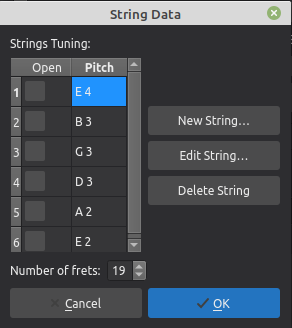
2. Press the `Edit String Data…` button at the bottom of the dialog box. This opens the **String Data** dialog:\\
3. Under **Strings tuning**, click on a string pitch and select `Edit String…`; Alternatively, just double-click the string pitch.
4. Select a new pitch in the Note Selection box and click `OK`. Alternatively, just double-click the new pitch.
5. Click `OK` to close the “String Data” dialog box.
6. Click `OK` to close the Staff/Part Properties dialog.
*Huomautuksia*: (1) Jos viritystä muutetaan tabulatuuriviivastossa, joka sisältää jo nuotteja, nauhamerkit säädetään automaattisesti (jos mahdollista); (2) Mikä tahansa virityksen muutos tietylle soittimelle koskee vain kyseistä partituuria, eikä muuta mitään ohjelman oletusasetuksia.
## Adding or removing strings
### Add a string
1. Klikkaa viivastoa hiiren oikealla ja valitse **Viivaston/stemman ominaisuudet...**
2. Click on `Edit String Data…`
3. Click on a string pitch and select `New String…`
4. Select the new pitch and press `OK`; alternatively, just double-click the new pitch.
The new string is inserted *below* the selected string. You will also need to adjust the number of lines in [Staff/Part properties→Advanced style properties](/fi/notation/instruments-staves-and-systems/staff-part-properties.md#advanced-style-properties).
### Delete a string
1. Klikkaa viivastoa hiiren oikealla ja valitse **Viivaston/stemman ominaisuudet…**
2. Click on `Edit String Data…`
3. Click on a string pitch and press `Delete String`.
*Note*: After deleting a tablature string you will also need to adjust the number of lines in [Staff/Part properties→Advanced style properties](/fi/notation/instruments-staves-and-systems/staff-part-properties.md#advanced-style-properties).
## Mark unfretted string “open”
Esimerkiksi barokkiluutun kaltaisille soittimille tätä ominaisuutta käytetään merkitsemään bassokielipari nauhattomaksi – eli se soitetaan aina avoimena kuten harpunkieli. Tämä tarkoittaa, että voidaan näyttää vain nauhamerkki, joka osoittaa nollanauhaa.
Bassokieliparin nauhattomaksi merkitseminen:
1. Klikkaa viivastoa hiiren oikealla ja valitse **Viivaston/stemman ominaisuudet...**
2. Click on `Edit String Data…`
3. Merkitse vaaditut valintaruudut **Avoin**-sarakkeessa.
Katso myös [Aikakauden tabulatuurin nuotinnus](/fi/idiomatic-notation/guitar/entering-and-editing-tablature-notation.md#period-tablature-notation).
## Change number of instrument frets
Tämä ominaisuus määrittelee nauhojen enimmäismäärän, joka voidaan syöttää tabulatuuriviivastoon.
1. Klikkaa viivastoa hiiren oikealla ja valitse **Viivaston/stemman ominaisuudet...**
2. Click on `Edit String Data…`
3. Valitse tai syötä uusi numero käyttäen "Nauhojen lukumäärä" -säädintä.
## Changing tablature staff type
MuseScore tarjoaa joukon yleisiä tabulatuurityyppejä. Jos haluat muuttaa tabulatuurintyyppiä, valitse toinen kahdesta vaihtoehdosta:
### Change staff type from the Layout panel
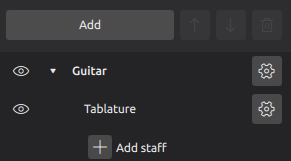
1. Varmista, että **Asettelu**-paneeli on näkyvissä (kytke `F7`-näppäimellä).
2. Nuolen klikkaaminen soittimen nimen vieressä näyttää viivastot.
3. Klikkaa haluamasi viivaston vieressä olevaa muokkausratasta ja valitse vaihtoehto "Viivastotyyppi" pudotusvalikosta.
4. Paina `Esc` kun haluat sulkea, tai klikkaa valintaikkunan ulkopuolella.
### Change staff type from Staff/Part properties
1. Right-click onto an empty area of the staff and select `Staff/Part Properties…`.
2. Click on `Advanced Style properties`, select the desired option from "Template", then press `< Reset to Template`. You can fine tune the display if necessary using the "Fret Marks" and "Note Values" tabs.
3. Click `OK` twice to exit.
*Huom.*: Mukautusasetuksista tarkemmin, katso [Tabulatuurin ulkoasun mukauttaminen](#customizing-appearance-of-tablature) (alla).
Termit 'yksinkertainen', 'yleinen' ja 'täysi' löytyvät tabulatuurintyyppien nimistä:
* **Yksinkertainen**: Näyttää vain nauhamerkit.
* **Yleinen**: Näyttää nauhamerkit, tauot, varret ja palkit.
* **Täysi**: Näyttää nauhamerkit; tauot, varret ja palkit sekä puolinuotin varret.
## Customizing appearance of tablature
### Tablature staff properties
1. Klikkaa viivastoa hiiren oikealla ja valitse **Viivaston/stemman ominaisuudet...**
2. Click on `Advanced Style Properties…`.
This gives you access to a full range of tablature customization options. See [Staff properties: Tablature options](/fi/notation/instruments-staves-and-systems/staff-part-properties.md#advanced-style-properties-settings-for-tablature-staff-type-2).
### Tablature staff style
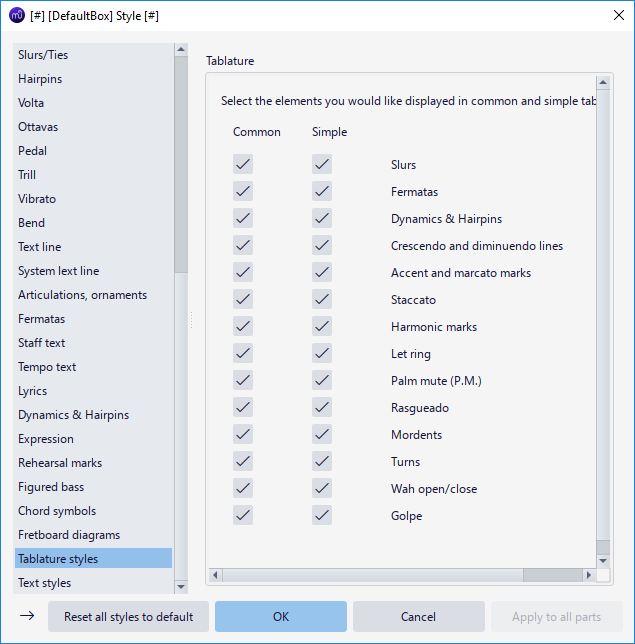
Yleiset asetukset määritetään kohdassa **Muotoilu → Tyyli → Tabulatuurityylit**.\\
---
# Agent Instructions
This documentation is published with GitBook. GitBook is the documentation platform designed so that both humans and AI agents can read, navigate, and reason over technical content effectively. Learn more at gitbook.com.
## Querying This Documentation
If you need additional information that is not directly available in this page, you can query the documentation dynamically by asking a question.
Perform an HTTP GET request on the current page URL with the `ask` query parameter, and the optional `goal` query parameter:
```
GET https://handbook.musescore.org/fi/idiomatic-notation/guitar/customizing-a-tablature-staff.md?ask=&goal=
```
`ask` is the immediate question: it should be specific, self-contained, and written in natural language.
`goal` is optional and describes the broader end goal you are ultimately trying to accomplish on behalf of the user. GitBook uses it to tailor the answer towards what is most useful for that goal.
The response will contain a direct answer to the question and relevant excerpts and sources from the documentation.
Use this mechanism when the answer is not explicitly present in the current page, you need clarification or additional context, or you want to retrieve related documentation sections.