> For the complete documentation index, see [llms.txt](https://handbook.musescore.org/llms.txt). Markdown versions of documentation pages are available by appending `.md` to page URLs; this page is available as [Markdown](https://handbook.musescore.org/fi/idiomatic-notation/guitar/creating-a-tablature-staff.md). Agents can also search and read this documentation through its [MCP server](https://handbook.musescore.org/~gitbook/mcp).
# Tabulatuuriviivaston luominen
## Overview
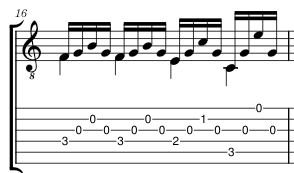
Music for fretted, stringed instruments is commonly notated using **tablature** (often abbreviated as **tab**); this gives a visual representation of the strings and fret numbers. Tablature is frequently found in combination with traditional staff notation.
## Types of tablature staves
Tarjolla on useita tabulatuuripohjia yleisille soittimille. Jos tämä ei ole aivan etsimäsi, voit helposti vaihtaa mallia (katso [Tabulatuuriviivaston tyypin muuttaminen](https://handbook.musescore.org/fi/idiomatic-notation/guitar/customizing-a-tablature-staff.md#changing-tablature-staff-type)) ja/tai mukauttaa viivastoa (katso [Tabulatuuri: mukauttaminen](https://handbook.musescore.org/fi/idiomatic-notation/guitar/customizing-a-tablature-staff.md)).
## Adding a tablature staff to your score
On kolme mahdollisuutta:
* [Tabulatuurin luominen osana uutta partituuria](#add-tablature-using-the-new-score-dialog).
* [Tabulatuurin lisääminen olemassa olevaan partituuriin](#add-tablature-using-the-add-or-remove-instruments-dialog).
* [Olemassa olevan viivaston muuttaminen normaalista tabulatuuriksi](#change-an-existing-staff-from-standard-to-tablature).
### Add tablature using the New Score dialog
Tabulatuurin luominen osana uutta partituuria:
1. Avaa [Uusi partituuri](https://handbook.musescore.org/fi/basics/setting-up-your-score.md) -valintaikkuna.
2. Valitse tarvittava tabulatuuri joko **Valitse soittimet** -välilehdeltä tai **Luo mallipohjasta** -välilehdeltä.
3. Viimeistele Uusi partituuri -valintaikkunan loppuosa.
### Add tablature using the Instruments dialog
Tabulatuuriviivaston luominen olemassa olevaan partituuriin:
1. In the **Layout** panel, click on the `Add` button; or press the shortcut key, `I`. This brings up the **Add or remove instruments** dialog.
2. Klikkaa **Kielisoittimet – Näppäiltävät** -ryhmää ja valitse haluamasi tabulatuuri **Soittimet**-sarakkeesta.
3. Press `OK`.
### Change an existing staff from standard to tablature
1. Varmista, että normaali viivasto sisältää näppäiltävän kielisoittimen;
2. Käytä jotakin kohdassa [Tabulatuuriviivaston tyypin muuttaminen](https://handbook.musescore.org/fi/idiomatic-notation/guitar/customizing-a-tablature-staff.md#changing-tablature-staff-type) kuvattuja menetelmiä.
## Creating paired standard and tablature staves
Kitaramusiikki (ja muiden näppäiltävien kielisoitinten musiikki) nuotinnetaan usein paritetulla normaali- *ja* tabulatuuriviivastolla. MuseScoressa viivastot voivat olla joko *linkitettyjä* tai *linkittämättömiä*.
* **Linkitetty**: Mikä tahansa yhden viivaston nuotinnukseen tekemäsi muutos päivittää toisen automaattisesti.
* **Linkittämätön**: Kumpaakin viivastoa muokataan itsenäisesti. Päivittääksesi toisen viivaston, kopioi ja liitä asiaankuuluva nuotinnus.
*Huom.*: Molemmissa tapauksissa viivasto/tabulatuuri-pari käyttää *samaa* soitinta.
### Create paired standard/tab staves using the New Score Wizard
Tähän on kaksi tapaa uutta partituuria luotaessa (A tai B):
**A.** Vain *linkitetyille* viivastoille:
1. Avaa Uusi partituuri -avustaja.
2. Siirry "Luo mallipohjasta" -välilehdelle, klikkaa "Soolo" -luokkaa ja valitse "Kitara + tabulatuuri".
3. Viimeistele Uusi partituuri -avustajan loppuosa.
4. Change the instrument type, if required, in [Staff / Part properties](https://handbook.musescore.org/fi/notation/instruments-staves-and-systems/staff-part-properties.md).
5. Vaihda tabulatuurin tyyppiä tarvittaessa (katso [Tabulatuuriviivaston tyypin muuttaminen](https://handbook.musescore.org/fi/idiomatic-notation/guitar/customizing-a-tablature-staff.md#changing-tablature-staff-type)).
B**. Linkitetyille *****tai***** linkittämättömille viivastoille:**
1. Avaa Uusi partituuri -avustaja.
2. Siirry "Valitse soittimet" -välilehdelle, klikkaa "Näppäilysoittimet" -ryhmää ja valitse viivastovaihtoehto "Soittimet" -sarakkeesta.
3. Viimeistele avustaja.
4. Add the desired staff using the [Instruments panel](https://handbook.musescore.org/fi/notation/instruments-staves-and-systems/instruments-and-system-markings.md).
### Create paired standard/tab staves using the Instruments dialog
Käytä tätä menetelmää, kun haluat lisätä olemassa olevaan partituuriin:
1. Open the **Add or remove instruments** dialog: press `I`; or, alternatively, the `Add` button in the **Instruments** sidebar
2. Klikkaa **Näppäilysoittimet** -ryhmää ja valitse haluamasi viivasto Soittimet-sarakkeesta.
3. Press `OK`.
4. Add the desired tablature from the [**Layout** panel](https://handbook.musescore.org/fi/notation/instruments-staves-and-systems/instruments-and-system-markings.md).
**Note**: If you already have one staff of a standard/tab pair in your score, you can simply add the missing staff from the **Instruments** panel. See [Adding and configuring staves](https://handbook.musescore.org/fi/notation/instruments-staves-and-systems/instruments-and-system-markings.md#adding-and-configuring-staves).
---
# Agent Instructions
This documentation is published with GitBook. GitBook is the documentation platform designed so that both humans and AI agents can read, navigate, and reason over technical content effectively. Learn more at gitbook.com.
## Querying This Documentation
If you need additional information that is not directly available in this page, you can query the documentation by asking a question.
Perform an HTTP GET request on the following URL with the `ask` and `goal` query parameters:
```
GET https://handbook.musescore.org/fi/idiomatic-notation/guitar/creating-a-tablature-staff.md?ask=&goal=
```
`ask` is the immediate question: it should be specific, self-contained, and written in natural language.
`goal` is what the user is ultimately trying to achieve, the reason they need the answer. Sharing it helps GitBook give you a better, more relevant answer. A goal is most helpful when it describes the outcome the user wants rather than restating the question. For example, with `ask=how do I create an API token`, a goal like `automate deployments from our CI pipeline` lets GitBook tailor the answer to that use case.
The response will contain a direct answer to the question and relevant excerpts and sources from the documentation.
Use this mechanism when the answer is not explicitly present in the current page, you need clarification or additional context, or you want to retrieve related documentation sections.