> For the complete documentation index, see [llms.txt](https://handbook.musescore.org/llms.txt). Markdown versions of documentation pages are available by appending `.md` to page URLs; this page is available as [Markdown](https://handbook.musescore.org/en_gb/idiomatic-notation/keyboard/cross-staff-notation.md).
# Cross-stave notation
## Creating cross-staff notation
1. First of all, enter the notation on one staff only
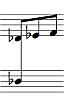
2. Select a note in the [voice](/en_gb/basics/working-with-multiple-voices.md) that you wish to move up or down to the other staff, e.g.\

3. Press Ctrl+Shift+Up/Down (Mac: Cmd+Shift+Up/Down), to move the voice up or down to the other staff. Alternatively, you can click on the cross-staff icon in the toolbar and choose the same options from the context menu.\

**Note**: Currently it is not possible to move individual notes of a chord from one stave to another; if you move one note, the whole chord will move. Therefore, if you want certain notes to remain on the original staff, they should be moved to a different voice. Also, be aware that notes which are moved to a different staff in this way still belong logically to the staff of origin - they are just drawn on a different staff. This is why no rest is shown on the staff where the notes have been moved from.
## See also
[How to span a chord or stem over two staves](https://musescore.org/en/node/8717)
---
# Agent Instructions
This documentation is published with GitBook. GitBook is the documentation platform designed so that both humans and AI agents can read, navigate, and reason over technical content effectively. Learn more at gitbook.com.
## Querying This Documentation
If you need additional information that is not directly available in this page, you can query the documentation dynamically by asking a question.
Perform an HTTP GET request on the current page URL with the `ask` query parameter, and the optional `goal` query parameter:
```
GET https://handbook.musescore.org/en_gb/idiomatic-notation/keyboard/cross-staff-notation.md?ask=&goal=
```
`ask` is the immediate question: it should be specific, self-contained, and written in natural language.
`goal` is optional and describes the broader end goal you are ultimately trying to accomplish on behalf of the user. GitBook uses it to tailor the answer towards what is most useful for that goal.
The response will contain a direct answer to the question and relevant excerpts and sources from the documentation.
Use this mechanism when the answer is not explicitly present in the current page, you need clarification or additional context, or you want to retrieve related documentation sections.