> For the complete documentation index, see [llms.txt](https://handbook.musescore.org/llms.txt). Markdown versions of documentation pages are available by appending `.md` to page URLs; this page is available as [Markdown](https://handbook.musescore.org/customization/appearance.md).
# Appearance
## Overview
To change the appearance of MuseScore
1. From the menu, select **Edit→Preferences...** (Mac: **MuseScore→Preferences...**);
2. In the `Appearance` tab, select the desired option described below.
## Theme and Colors
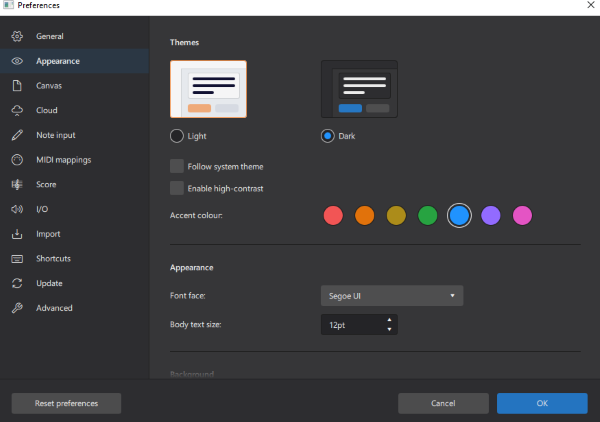
The following options are available to change the colors of MuseScore. The display changes immediately so options can be tested without closing the dialog. The changes apply to all open instances of MuseScore (see [Windows](/customization/toolbars-and-windows.md#toolbarsandwindows-windows))
* Light or Dark Theme
* Select "Follow system theme" if you want MuseScore to change themes from light to dark, or dark to light, when the system theme changes
* Enable high-contrast
* Accent color options
* Background - the color behind the score (not the color of palettes and other program items) can be changed to a solid color or a Wallpaper image.
* Paper - the color of the score itself can be changed to a solid color or a Wallpaper image.
* Invert Score - swaps the color of score elements with the Paper color
## Fonts
To change the font face and text size for Menu and Palette elements:
1. From the menu, select **Edit→Preferences...** (Mac: **MuseScore→Preferences...**);
2. In the `Appearance` tab, select the font options.
This does not affect and text elements in the score.
---
# Agent Instructions
This documentation is published with GitBook. GitBook is the documentation platform designed so that both humans and AI agents can read, navigate, and reason over technical content effectively. Learn more at gitbook.com.
## Querying This Documentation
If you need additional information that is not directly available in this page, you can query the documentation dynamically by asking a question.
Perform an HTTP GET request on the current page URL with the `ask` query parameter, and the optional `goal` query parameter:
```
GET https://handbook.musescore.org/customization/appearance.md?ask=&goal=
```
`ask` is the immediate question: it should be specific, self-contained, and written in natural language.
`goal` is optional and describes the broader end goal you are ultimately trying to accomplish on behalf of the user. GitBook uses it to tailor the answer towards what is most useful for that goal.
The response will contain a direct answer to the question and relevant excerpts and sources from the documentation.
Use this mechanism when the answer is not explicitly present in the current page, you need clarification or additional context, or you want to retrieve related documentation sections.